

What is cyber warfare?
Cyber warfare is usually defined as a cyber attack or series of attacks that target a country. It has the potential to wreak havoc on government and civilian infrastructure and disrupt critical systems, resulting in damage to the state and even loss of life.
There is, however, a debate among cyber security experts as to what kind of activity constitutes cyber warfare. The US Department of Defense (DoD) recognizes the threat to national security posed by the malicious use of the Internet but doesn’t provide a clearer definition of cyber warfare. Some consider cyber warfare to be a cyber attack that can result in death.
Although cyberwarfare generally refers to cyber attacks perpetrated by one nation-state on another, it can also describe attacks by terrorist groups or hacker groups aimed at furthering the goals of particular nations. While there are a number of examples of suspected cyberwarfare attacks in recent history, there has been no formal, agreed-upon definition for a cyber act of war, which experts generally agree would be a cyber attack that directly leads to loss of life.
What kinds of cyber weapons are used in warfare?
Examples of acts that might qualify as cyberwarfare include the following:
- viruses, phishing, computer worms and malware that can take down critical infrastructure;
- distributed denial-of-service (DDoS) attacks that prevent legitimate users from accessing targeted computer networks or devices;
- hacking and theft of critical data from institutions, governments and businesses;
- spyware or cyber espionage that results in the theft of information that compromises national security and stability;
- ransomware that holds control systems or data hostage; and
- propaganda or disinformation campaigns used to cause serious disruption or chaos.
7 Types of Cyber Warfare Attacks
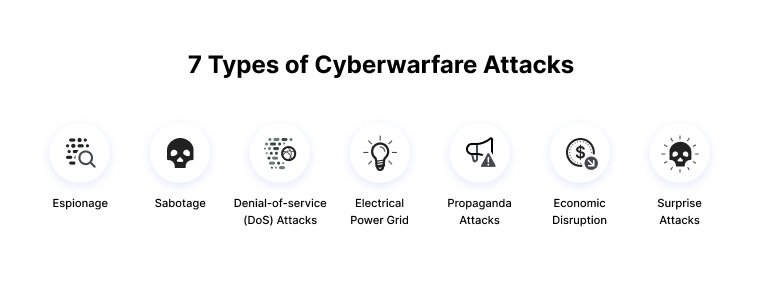
Here are some of the main types of cyber warfare attacks.
1-Espionage
Refers to monitoring other countries to steal secrets. In cyber warfare, this can involve using botnets or spear phishing attacks to compromise sensitive computer systems before exfiltrating sensitive information.
2-Sabotage
Government organizations must determine sensitive information and the risks if it is compromised. Hostile governments or terrorists may steal information, destroy it, or leverage insider threats such as dissatisfied or careless employees, or government employees with affiliation to the attacking country.
3-Denial-of-service (DoS) Attacks
DoS attacks prevent legitimate users from accessing a website by flooding it with fake requests and forcing the website to handle these requests. This type of attack can be used to disrupt critical operations and systems and block access to sensitive websites by civilians, military and security personnel, or research bodies.
4-Electrical Power Grid
Attacking the power grid allows attackers to disable critical systems, disrupt infrastructure, and potentially result in bodily harm. Attacks on the power grid can also disrupt communications and render services such as text messages and communications unusable.
5-Propaganda Attacks
Attempts to control the minds and thoughts of people living in or fighting for a target country. Propaganda can be used to expose embarrassing truths, spread lies to make people lose trust in their country, or side with their enemies.
6-Economic Disruption
Most modern economic systems operate using computers. Attackers can target computer networks of economic establishments such as stock markets, payment systems, and banks to steal money or block people from accessing the funds they need.
7-Surprise Attacks
These are the cyber equivalent of attacks like Pearl Harbor and 9/11. The point is to carry out a massive attack that the enemy isn’t expecting, enabling the attacker to weaken their defenses. This can be done to prepare the ground for a physical attack in the context of hybrid warfare.
Examples of Cyber Warfare Operations
Here are several well-publicized examples of cyber warfare in recent times.
Stuxnet Virus
Stuxnet was a worm that attacked the Iranian nuclear program. It is among the most sophisticated cyber attacks in history. The malware spread via infected Universal Serial Bus devices and targeted data acquisition and supervisory control systems. According to most reports, the attack seriously damaged Iran’s ability to manufacture nuclear weapons.
Sony Pictures Hack
An attack on Sony Pictures followed the release of the film “The Interview”, which presented a negative portrayal of Kim Jong Un. The attack is attributed to North Korean government hackers. The FBI found similarities to previous malware attacks by North Koreans, including code, encryption algorithms, and data deletion mechanisms.
Bronze Soldier
In 2007, Estonia relocated a statue associated with the Soviet Union, the Bronze Soldier, from the center of its capital Tallinn to a military cemetery near the city. Estonia suffered a number of significant cyber attacks in the following months. Estonian government websites, media outlets, and banks were overloaded with traffic in massive denial of service (DoS) attacks and consequently were taken offline.
Fancy Bear
CrowdStrike claims that the Russian organized cybercrime group Fancy Bear targeted Ukrainian rocket forces and artillery between 2014 and 2016. The malware was spread via an infected Android application used by the D-30 Howitzer artillery unit to manage targeting data.
Ukrainian officers made wide use of the app, which contained the X-Agent spyware. This is considered to be a highly successful attack, resulting in the destruction of over 80% of Ukraine’s D-30 Howitzers.
Enemies of Qatar
Elliott Broidy, an American Republican fundraiser, sued the government of Qatar in 2018, accusing it of stealing and leaking his emails in an attempt to discredit him. The Qataris allegedly saw him as an obstacle to improving their standing in Washington.
According to the lawsuit, the brother of the Qatari Emir was alleged to have orchestrated a cyber warfare campaign, along with others in Qatari leadership. 1,200 people were targeted by the same attackers, with many of these being known “enemies of Qatar”, including senior officials from Egypt, Saudi Arabia, the United Arab Emirates, and Bahrain.

Leave a Reply